
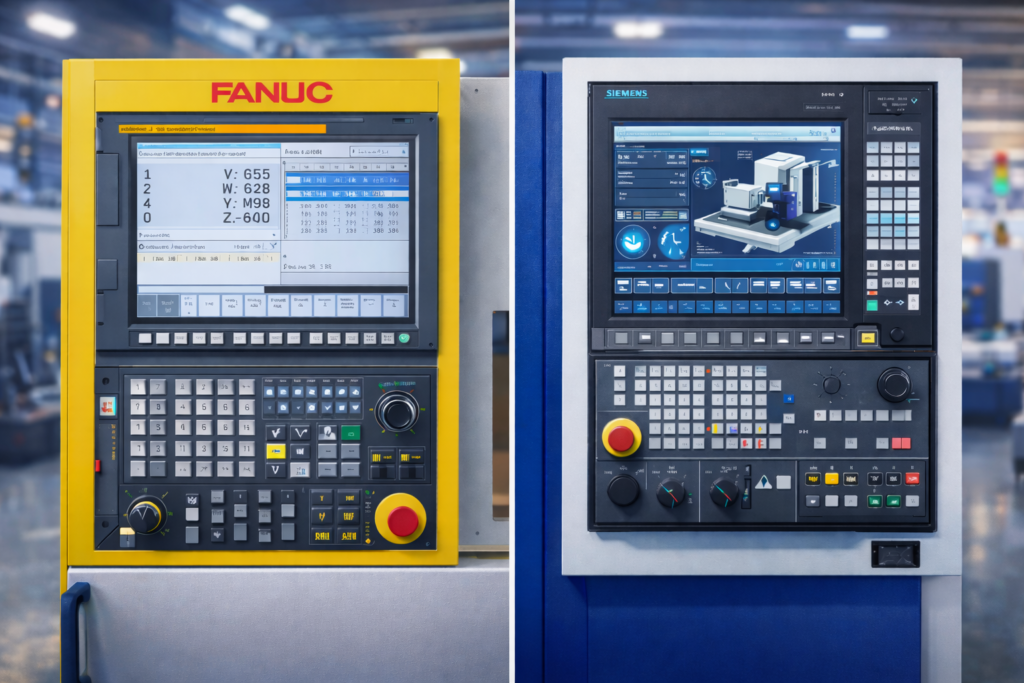
The Brain Behind CNC Precision
In the world of CNC machining, precision and efficiency hinge on one critical component: the CNC controller. Often referred to as the “brain” of the machine, controllers play a pivotal role in executing complex manufacturing tasks with unparalleled accuracy. Among the market leaders, FANUC and Siemens dominate the CNC controller landscape, each offering unique capabilities tailored to various manufacturing needs.
Choosing the right CNC controller can significantly impact productivity, cost, and flexibility. This blog unpacks the differences between FANUC and Siemens controllers to help manufacturers make informed decisions.
FANUC vs. Siemens – A Comprehensive Comparison
1. Overview of FANUC and Siemens Controllers
- FANUC:
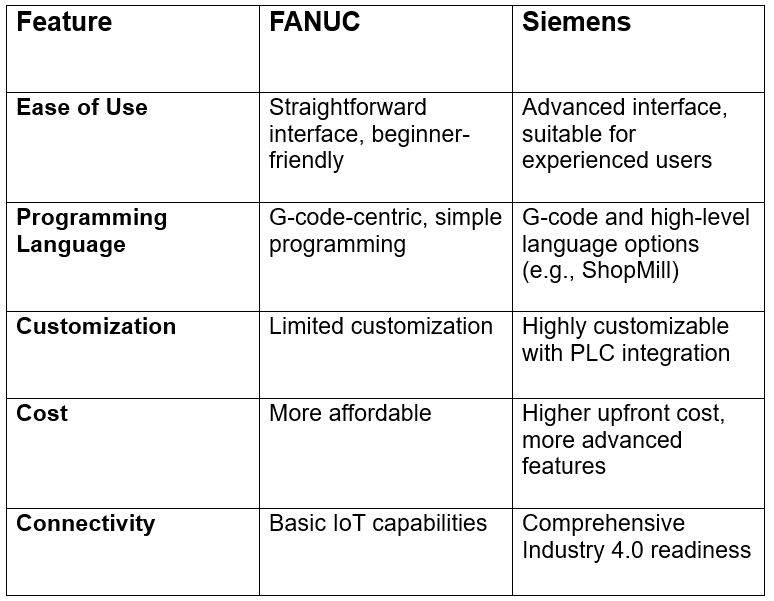
- Renowned for reliability and simplicity, FANUC controllers are widely used in industries such as automotive, aerospace, and consumer goods manufacturing.
- Its user-friendly interface and vast global support network make it a favorite for operators and maintenance teams.
- Siemens:
- Siemens controllers excel in versatility and integration capabilities, making them ideal for complex machining and multi-tasking operations.
- With advanced programming features and a focus on Industry 4.0 integration, Siemens caters to manufacturers seeking cutting-edge solutions.
Key Differences Between FANUC and Siemens Controllers
Application Scenarios
- When to Choose FANUC:
- Ideal for small to medium-scale manufacturers prioritizing reliability and ease of operation.
- Best suited for repetitive, high-volume production tasks in industries like automotive or FMCG.
- When to Choose Siemens:
- Perfect for industries requiring advanced multitasking and integration, such as aerospace or precision medical equipment.
- Recommended for manufacturers looking to future-proof operations with Industry 4.0.
Real-World Examples of Indian Companies Using These Controllers
- FANUC in Action:
Bajaj Auto, one of India’s largest two-wheeler manufacturers, extensively uses FANUC controllers for their CNC machining centers. The simplicity and reliability of FANUC systems ensure uninterrupted production lines for high-volume manufacturing. - Siemens in Practice:
Hindustan Aeronautics Limited (HAL) relies on Siemens controllers to produce intricate aerospace components. The advanced capabilities of Siemens CNC systems enable HAL to achieve the high precision required for aircraft and defense equipment manufacturing.
Technical Insights
1. Ease of Maintenance
- FANUC controllers offer robust hardware with straightforward troubleshooting processes.
- Siemens provides extensive diagnostic tools but requires advanced expertise for maintenance.
2. Software Integration
- FANUC focuses on plug-and-play solutions, ideal for standalone CNC machines.
- Siemens emphasizes seamless integration with advanced manufacturing systems, including robotic automation and digital twins.
3. User Training and Support
- FANUC’s widespread presence ensures accessible training programs and quick support.
- Siemens offers comprehensive training but caters more to specialized applications.
Conclusion: Choosing the Right CNC Controller
Selecting between FANUC and Siemens CNC controllers depends on your specific manufacturing needs. FANUC stands out for its simplicity and reliability, making it a practical choice for high-volume production. On the other hand, Siemens offers unmatched versatility and advanced features for manufacturers prioritizing precision and Industry 4.0 integration.