
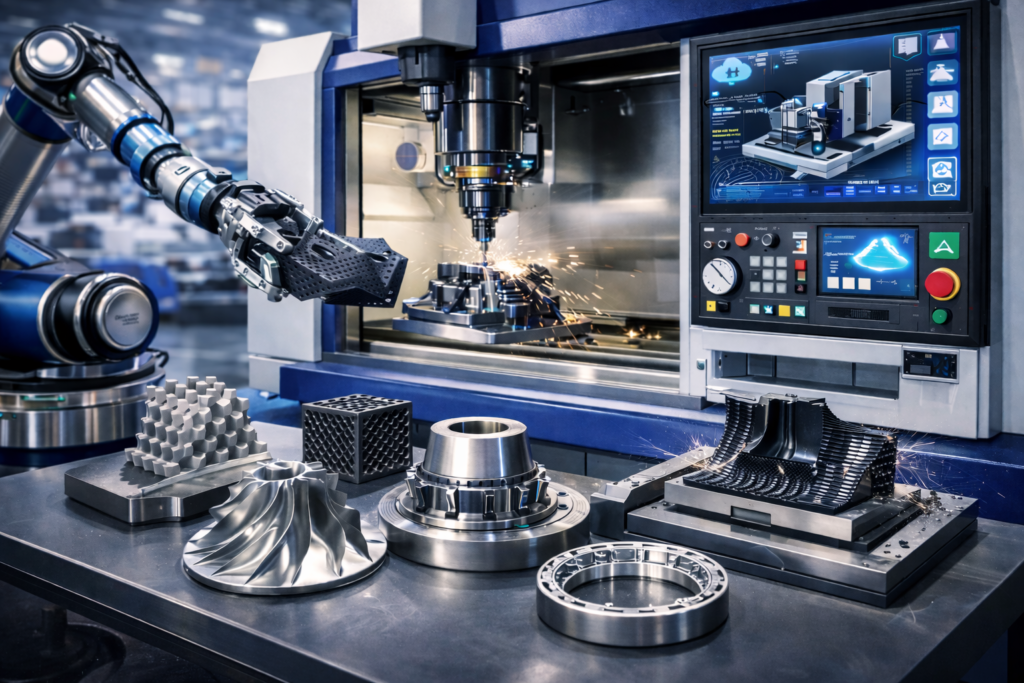
Tackling the Challenges of Advanced Materials with CNC Machining
The demand for advanced materials in industries like aerospace, healthcare, and automotive is skyrocketing. However, machining these materials—such as titanium alloys, carbon fiber composites, and ceramics—comes with unique challenges. Achieving high precision without compromising on quality requires cutting-edge solutions. This is where Computer Numerical Control (CNC) machining shines.
In this blog, we’ll explore how CNC technology is revolutionizing the machining of advanced materials, enabling industries to produce complex parts with unmatched accuracy.
What Makes Advanced Materials Difficult to Machine?
Advanced materials such as titanium alloys, carbon fiber composites, ceramics, and superalloys are becoming increasingly popular due to their exceptional properties. However, these materials introduce significant machining challenges:
- Tool Wear and Tear:
Advanced materials are incredibly hard and abrasive. This leads to rapid tool degradation, requiring frequent tool changes and increasing production costs. - Heat Generation:
High friction during machining can lead to excessive heat buildup. If not managed properly, this can cause thermal damage to both the tool and the workpiece, compromising product quality. - Precision Challenges:
Industries like aerospace and healthcare demand parts with tolerances in the micron range. Achieving such accuracy while machining these tough materials is complex and requires advanced solutions. - Surface Finish Requirements:
Many advanced materials need ultra-smooth finishes for their intended applications, such as medical implants or aerospace components. Achieving these finishes adds to the machining difficulty.
The CNC Advantage in High-Precision Machining
CNC machining has become the go-to solution for tackling the complexities of advanced materials. Here’s why:
- Unmatched Precision:
CNC machines are computer-controlled, ensuring highly accurate and repeatable results. They can work with tolerances as tight as ±0.001 mm, making them ideal for critical applications like jet engine components and surgical instruments. - Multi-Axis Capability:
With 3-axis, 4-axis, and even 5-axis CNC machines, manufacturers can machine intricate geometries without multiple setups. This reduces the chances of errors and accelerates production timelines. - Real-Time Adjustments:
Advanced CNC systems use sensors and AI-driven algorithms to monitor machining conditions and adjust feed rates, speeds, and cutting paths on the fly. This minimizes tool wear and ensures consistent quality. - Extended Tool Life:
CNC machines can integrate features like coolant delivery systems and vibration damping mechanisms to prolong tool life, even when machining abrasive materials like ceramics and composites. - Efficient Material Utilization:
CNC machining ensures minimal material wastage through precise cuts and optimized nesting strategies. For high-cost materials like carbon fiber and titanium, this can significantly reduce expenses.
The Role of Automation and Integration
Modern CNC machines don’t work in isolation. They are often integrated into larger automated systems, such as robotic arms for loading and unloading, or hybrid setups that combine CNC machining with additive manufacturing.
For example:
- Hybrid Manufacturing: CNC machines paired with 3D printing allow for rapid prototyping of complex designs, followed by precision machining to refine features.
- Automated Quality Checks: Post-machining, CNC systems can use advanced sensors and laser scanners to ensure parts meet design specifications.
Case Study: Tata Motors’ Use of CNC for Advanced Materials
Tata Motors, a leading Indian automotive giant, faced challenges in producing lightweight, high-strength parts for their electric vehicles. By integrating advanced CNC machining, they achieved:
- 30% Weight Reduction: Using CNC to machine aluminum alloys.
- Improved Durability: Optimized machining strategies enhanced part longevity.
- Cost Savings: Automation reduced material wastage by 20%.
This success showcases how CNC can be a game-changer in advanced materials machining.
Technical Insights
- Multi-Axis CNC Machines:
- 5-axis machines are ideal for complex aerospace and medical components.
- They allow machining from multiple angles without re-clamping, reducing errors.
- Tooling Innovations:
- Tools made from polycrystalline diamond (PCD) or cubic boron nitride (CBN) resist wear during machining of hard materials.
- Simulation Software:
- Modern CNC systems integrate CAD/CAM software for error-free machining.
- Hybrid CNC Machines:
- Combining CNC with additive manufacturing for prototyping and complex designs.
Conclusion
CNC machining is not just a tool but a necessity for industries working with advanced materials. By leveraging CNC’s precision, adaptability, and efficiency, manufacturers can overcome challenges and stay ahead in competitive markets. At Mechinex, we specialize in delivering tailored CNC solutions that empower businesses to innovate and excel.