
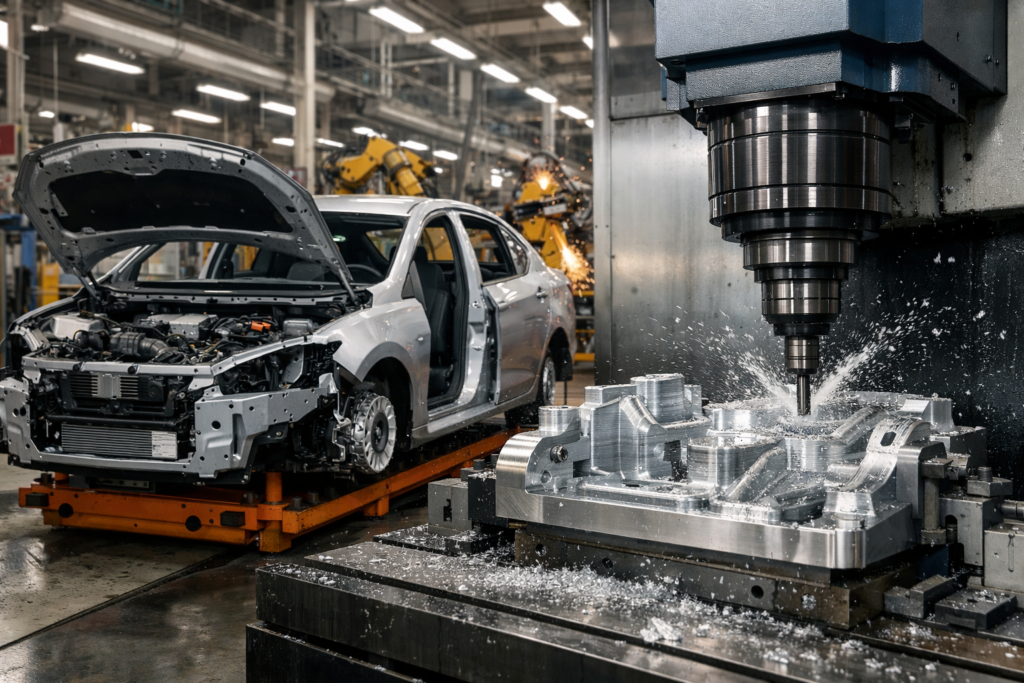
Revolutionizing Automotive Manufacturing
The automotive industry is driven by innovation and efficiency. As the demand for precision, cost-effectiveness, and mass production grows, CNC machining emerges as a game-changer. This technology bridges the gap between high-quality components and streamlined production processes. But what makes CNC machining so integral to the automotive industry? Let’s explore its transformative role and why it’s indispensable for today’s manufacturers.
How CNC Machining Drives the Automotive Industry
1. Precision at Scale
CNC (Computer Numerical Control) machining ensures unparalleled precision. Automotive parts, from engine blocks to transmission components, demand exact specifications to function effectively. CNC machines, with their ability to follow complex designs, deliver this precision repeatedly, reducing human error and ensuring consistency.
2. Versatility Across Materials
From lightweight aluminum to high-strength steel and advanced composites, CNC machining handles a wide variety of materials. This flexibility enables manufacturers to produce components tailored to specific needs, whether it’s a durable chassis or a lightweight engine part to improve fuel efficiency.
3. Cost-Effective Manufacturing
With automated production processes, CNC machining reduces labor costs while increasing production speed. Additionally, its ability to produce multiple components in a single run saves valuable time, making it an ideal solution for the competitive automotive market.
4. Seamless Prototyping and Customization
CNC machining excels in prototyping, enabling manufacturers to test and refine designs quickly. For custom vehicle parts, such as limited-edition components, CNC machines adapt seamlessly to create intricate, bespoke pieces.
5. Enhanced Durability and Quality Control
Automotive components face rigorous conditions, from extreme temperatures to constant wear and tear. CNC machining ensures parts meet stringent durability standards, contributing to vehicle reliability and safety. Its precision also simplifies quality control, ensuring every part meets or exceeds expectations.
Case Study: Tata Motors’ Use of CNC Machining
Tata Motors, one of India’s leading automotive giants, leverages CNC machining to stay ahead in the industry. By incorporating CNC technology into their manufacturing processes, Tata Motors achieves:
- Improved Efficiency: Faster production times for key components such as cylinder heads and gearboxes.
- Enhanced Precision: High-performance engine parts crafted to exact specifications.
- Cost Savings: Significant reductions in waste material and labor costs.
Their adoption of CNC machining underscores its critical role in modern automotive manufacturing, proving that innovation drives success.
Technical Insights: Why CNC Machining Outperforms Traditional Methods
- Automation: Advanced software controls reduce manual intervention.
- 5-Axis Machining: Enables production of complex geometries with fewer setups.
- High Tolerances: Achieves tolerances as low as ±0.001 inches, crucial for automotive parts.
- Tool Versatility: Multiple tool options for drilling, milling, and turning ensure adaptability.
Conclusion: Driving the Future of Automotive Manufacturing
CNC machining is not just a manufacturing tool; it’s a revolution in the automotive industry. By enabling precision, efficiency, and cost-effectiveness, CNC machining supports innovation and growth. As companies like Tata Motors demonstrate, embracing CNC technology is essential to remain competitive and deliver world-class vehicles.