
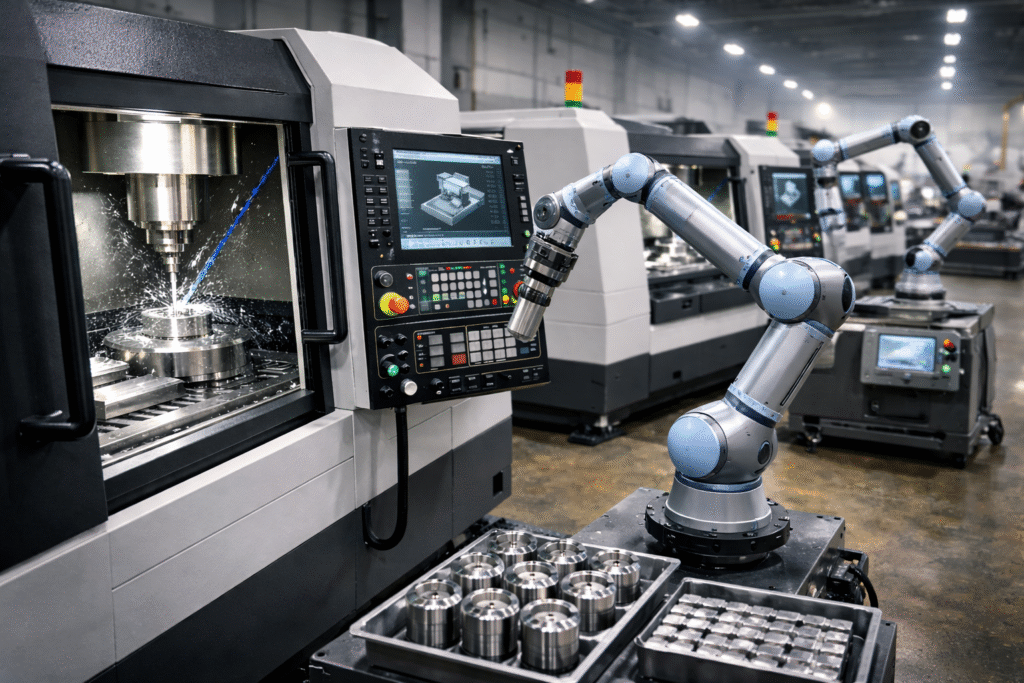
The Evolution of CNC and Its Role in Modern Manufacturing
In a world driven by innovation, Computer Numerical Control (CNC) technology has consistently pushed the boundaries of modern manufacturing. From enhancing precision to enabling mass production, CNC machines have proven indispensable in industries like aerospace, automotive, healthcare, and electronics.
Yet, as manufacturing embraces the era of Industry 4.0, CNC technology is on the cusp of a revolutionary transformation. What does the future hold for CNC machines in this rapidly evolving landscape? In this blog, we’ll explore the advancements shaping the future of CNC technology and its role in smart manufacturing.
Emerging Trends and Innovations in CNC Technology
1. Integration with Artificial Intelligence (AI)
AI-powered CNC machines are transforming how manufacturers operate. By analyzing vast amounts of data in real time, these machines can:
- Predict maintenance needs, minimizing downtime.
- Optimize tool paths for faster and more efficient machining.
- Learn from previous operations to improve accuracy and reduce errors.
For example, predictive maintenance powered by AI ensures that manufacturers can proactively address wear and tear, avoiding costly disruptions.
2. IoT-Enabled CNC Machines
The Internet of Things (IoT) is redefining connectivity in manufacturing. IoT-enabled CNC machines can:
- Provide real-time monitoring of performance metrics.
- Send alerts for performance deviations.
- Streamline workflows by communicating with other equipment on the shop floor.
This connectivity ensures seamless production lines and improved collaboration between machines and human operators.
3. Hybrid CNC Machines
Hybrid CNC machines combine additive and subtractive manufacturing, enabling:
- The creation of complex geometries that traditional machining cannot achieve.
- Cost-effective prototyping and production.
- Reduced material waste through precise additive manufacturing.
4. Multi-Axis Machining
The evolution from 3-axis to 5-axis and beyond allows for:
- Manufacturing of intricate parts in a single setup.
- Increased versatility in machining complex shapes.
- Shortened production cycles and higher accuracy.
Case Study: Reliance Industries and CNC Innovations
Reliance Industries, one of India’s largest conglomerates, has leveraged next-generation CNC technology to revolutionize its production processes. By integrating AI-driven CNC machines and IoT capabilities into their operations, Reliance achieved:
- A 25% reduction in production downtime.
- Enhanced precision in creating components for their petrochemical and energy sectors.
- Increased scalability to meet growing demands.
Their forward-thinking approach showcases the potential of CNC technology in driving efficiency and innovation.
Technical Insights: The Building Blocks of Future CNC Machines
- Advanced Materials for Tools Innovations in materials like diamond-coated tools and ceramics are improving durability and performance, ensuring better machining of hard-to-cut materials.
- Cloud-Based CNC Systems Cloud integration allows manufacturers to:
- Store and access design files remotely.
- Collaborate on projects across multiple locations.
- Update software instantly for enhanced functionality.
- Human-Machine Collaboration The rise of collaborative robots (cobots) working alongside CNC machines ensures:
- Enhanced productivity through automation of repetitive tasks.
- Improved safety with real-time monitoring of human-machine interactions.
Conclusion
As CNC technology continues to evolve, it’s paving the way for a smarter, more connected, and highly efficient manufacturing future. From AI-driven insights to hybrid capabilities, these advancements will empower businesses to stay competitive in an ever-changing global market. At Mechinex, we’re dedicated to helping manufacturers embrace the future of CNC technology. Discover our innovative CNC solutions here and take the first step towards smarter manufacturing.