
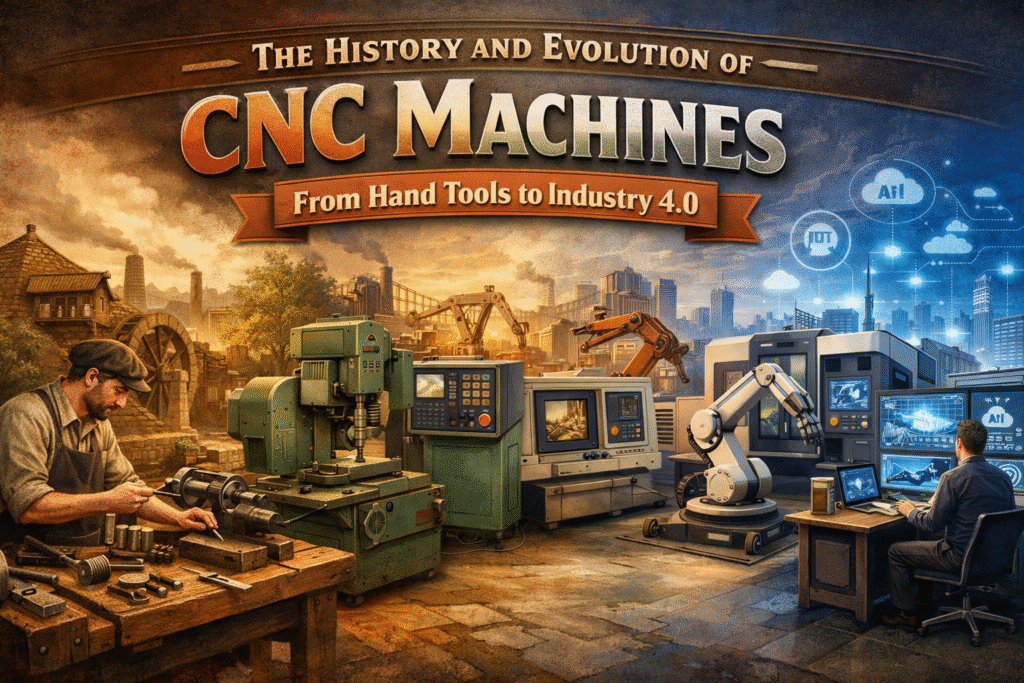
From Manual Work to Precision Automation
Since the dawn of civilization, humans have been seeking ways to make manufacturing faster, more precise, and less labor-intensive. From ancient artisans using hand tools to today’s complex CNC (Computer Numerical Control) machines, the journey of innovation has transformed the manufacturing landscape.
But how did we evolve from manual lathes to advanced, fully automated CNC systems? In this post, we’ll explore the history and evolution of CNC machines—unveiling milestones, technical advancements, and the future of manufacturing in the era of Industry 4.0.
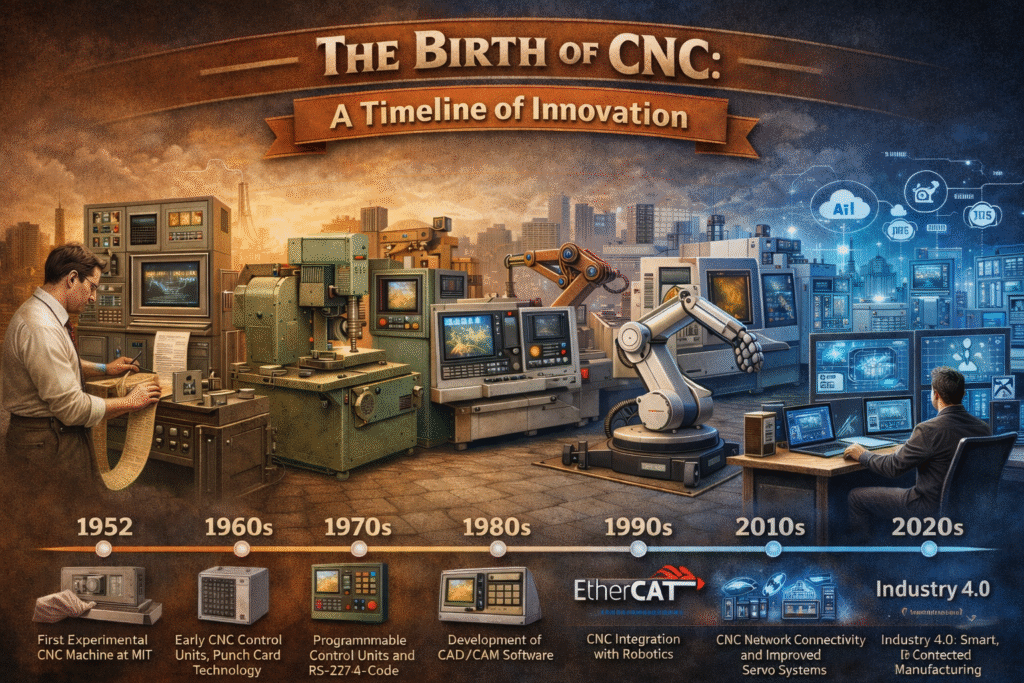
The Birth of CNC: A Timeline of Innovation
1. The Age of Manual Tools
In the early days, manufacturers relied solely on manual machines like lathes and mills. Artisans would control these tools by hand, focusing heavily on skill and craftsmanship. Precision was hard to achieve, especially at scale.
Key Challenge: Human error and limitations in production speed hindered consistency and mass production.
2. Introduction of Early Automation (1940s–1950s)
The first big leap came during World War II, when manufacturers needed better precision and repeatability to produce military equipment. Engineers developed numerical control (NC) machines powered by punched tape systems to ensure consistent production.
Fun Fact: John T. Parsons is credited with pioneering NC technology for the aircraft industry.
3. The Rise of CNC Machines (1970s)
By the 1970s, computers replaced punched tapes with digital controls, giving rise to the CNC machines we recognize today. This breakthrough meant that instead of manually operating the machine, operators could simply program instructions, allowing for:
- High precision
- Faster production times
- Reduced human intervention
Companies like Mechinex have utilized advanced CNC technology to meet the growing demand for complex, high-quality components. Learn more about CNC solutions.
4. CNC Machines in the 21st Century: Automation at Its Peak
With the advent of the Internet and cloud technologies, smart manufacturing became the next frontier. CNC systems integrated with:
- Robotics for material handling
- AI-powered software for predictive maintenance
- IoT sensors to monitor machine performance in real time
This era also saw the introduction of 5-axis CNC machines, which could perform complex cuts and angles in a single operation—dramatically improving efficiency.
5. The Future: CNC Machines in Industry 4.0
The next phase in CNC evolution aligns with Industry 4.0. Machines are now part of an interconnected ecosystem, capable of communicating with each other. Smart factories use CNC machines alongside robotic arms, 3D printers, and AI-driven software to achieve full automation.
Case Study:
1.Ford F-150’s Transformation
Ford Motor Company revolutionized the pickup truck market by using aluminum CNC machining for the Ford F-150. By replacing steel with aluminum components, the vehicle shed over 700 pounds, improving fuel efficiency without sacrificing durability. The precision of CNC machining ensured that complex parts fit perfectly, addressing both performance and production challenges.
2.Formula 1 and Red Bull Racing
In the world of high-performance racing, Red Bull Racing leverages CNC-machined components to reduce weight and boost speed. CNC technology helps produce parts such as engine blocks and suspension systems with extreme precision, balancing weight reduction with safety and strength—both essential for competitive racing performance.
3.Tesla’s Precision Manufacturing
Tesla incorporates CNC-machined components in electric vehicles, including motor housings and battery enclosures. These precision parts play a crucial role in ensuring long-lasting performance, contributing to Tesla’s reputation for quality and innovation in electric mobility.
This solution showcases how CNC technology can transform production efficiency. For more information, explore Mechinex’s CNC offerings.
Technical Insights: How CNC Machines Work
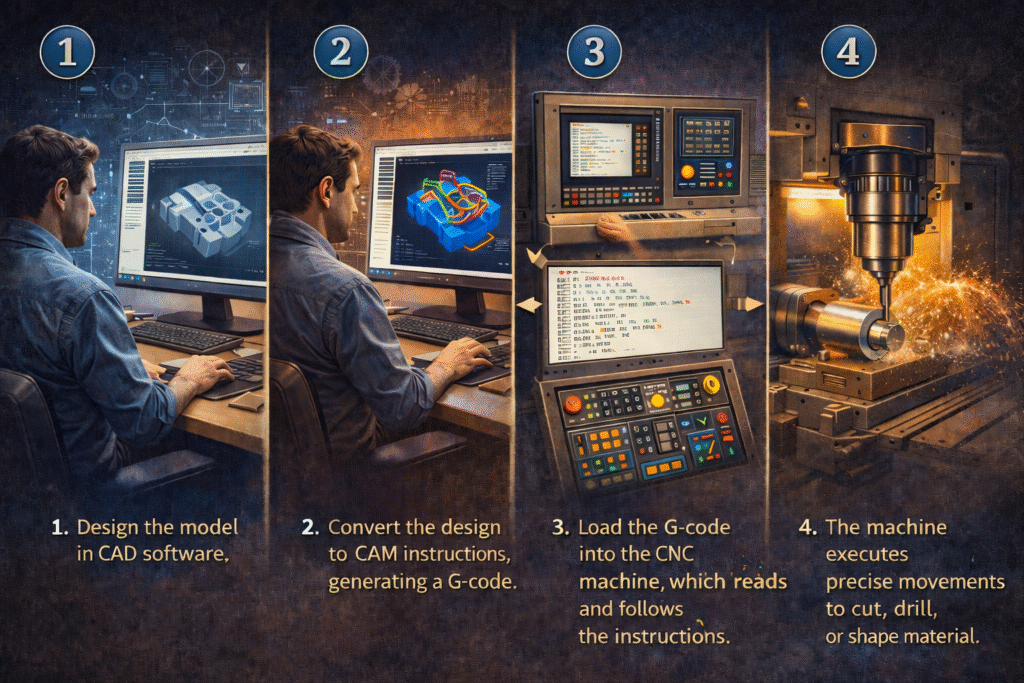
CNC machines follow G-code programming, a universal language that instructs machines on how to move. Here’s a quick breakdown of the process:
- Design the model in CAD software.
- Convert the design to CAM instructions, generating a G-code.
- Load the G-code into the CNC machine, which reads and follows the instructions.
- The machine executes precise movements to cut, drill, or shape the material.
- CNC Lathes – Ideal for turning operations.
- CNC Mills – Best for cutting complex shapes.
- Plasma Cutters – Use high-temperature plasma for cutting metal.
- Laser Cutters – Offer extremely fine precision for non-metal materials.
Conclusion: A New Era of Manufacturing Awaits
The evolution of CNC technology has redefined manufacturing—from simple hand tools to fully automated, connected machines. As we step into the future with Industry 4.0, CNC systems will play an even more critical role, ensuring precision, efficiency, and scalability.
Ready to take your production to the next level? Check out Mechinex’s cutting-edge CNC solutions and discover how you can revolutionize your manufacturing process.