
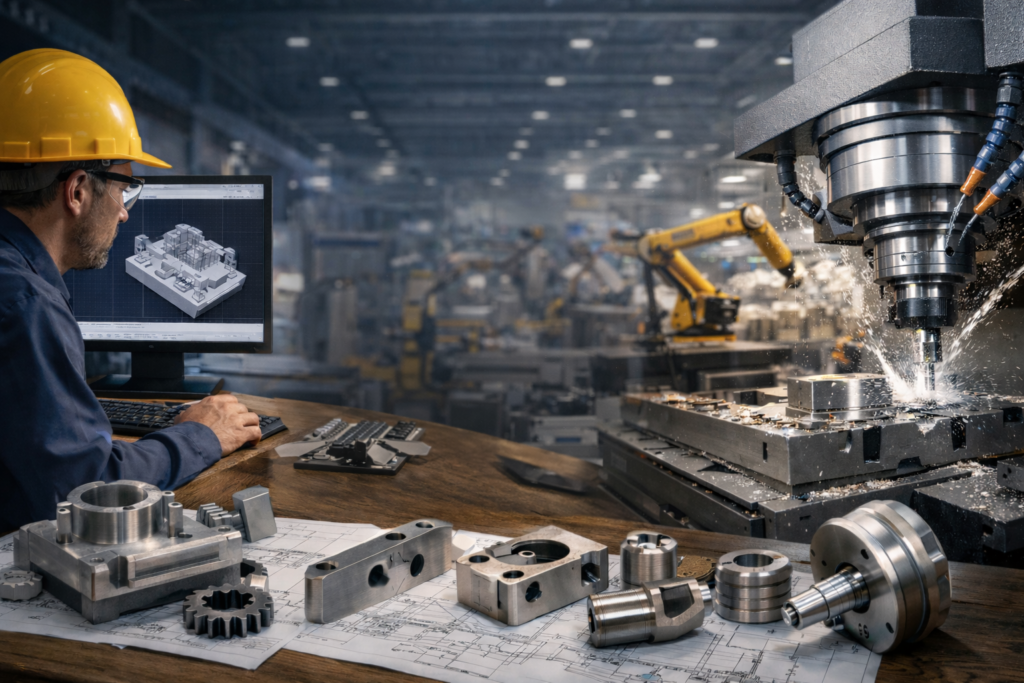
Simplifying Design and Production with DFMA
In today’s competitive manufacturing landscape, the ability to deliver high-quality products quickly and efficiently is paramount. However, inefficiencies in design and production can lead to wasted resources, higher costs, and delayed timelines. Enter Design for Manufacturing and Assembly (DFMA) a methodology that bridges the gap between product design and manufacturing feasibility.
But how do manufacturers ensure the precise execution of DFMA principles? CNC machines play a pivotal role, enabling the creation of complex parts with accuracy and repeatability. In this blog, we’ll explore what DFMA is, its importance, and how CNC technology is revolutionizing the process.
Understanding DFMA and Its Synergy with CNC Machines
1. What Is DFMA?
Design for Manufacturing and Assembly (DFMA) is a design approach that focuses on simplifying product manufacturing and assembly processes.
- Design for Manufacturing (DFM): Optimizes product designs to reduce production complexity and costs.
- Design for Assembly (DFA): Streamlines assembly processes to improve efficiency and minimize errors.
By incorporating DFMA principles early in the design phase, companies can enhance product quality, lower costs, and accelerate time-to-market.
2. How CNC Machines Empower DFMA
CNC (Computer Numerical Control) machines are a cornerstone of modern manufacturing. Their ability to precisely fabricate complex components aligns perfectly with DFMA goals.
- Enhanced Precision: CNC machines ensure tight tolerances, reducing the need for rework.
- Versatile Material Handling: From metals to composites, CNC machines can process diverse materials.
- Rapid Prototyping: CNC technology accelerates the prototyping phase, allowing faster validation of DFMA-optimized designs.
- Reduced Assembly Steps: Intricate components produced by CNC machines often require fewer assembly steps.
3. Industry Applications of DFMA with CNC Support
- Automotive: Optimizing lightweight designs for vehicle parts.
- Aerospace: Manufacturing intricate components for high-performance aircraft.
- Medical Devices: Creating compact and functional surgical tools.
Case Studies: Indian Companies Leveraging DFMA and CNC Technology
- Bharat Forge: Uses CNC machines for prototyping and producing lightweight, high-strength automotive parts, aligning with DFMA to reduce material waste and enhance performance.
- Godrej Aerospace: Implements DFMA principles supported by CNC machining to manufacture components for space missions, reducing complexity and improving reliability.
- Tata Motors: Adopts DFMA methodologies and CNC technology for creating modular car designs, enabling quicker assembly and improved scalability.
Technical Insights: CNC Machines and DFMA in Action
- Advanced CAD/CAM Integration:
CNC machines rely on CAD (Computer-Aided Design) and CAM (Computer-Aided Manufacturing) software to translate DFMA-optimized designs into precise machining operations. - Automation in Manufacturing:
CNC automation minimizes manual intervention, ensuring consistent quality and alignment with DFMA’s efficiency goals. - Tooling Advancements:
High-speed and multi-axis CNC machines enable the production of complex geometries with fewer setups.
Conclusion: The Perfect Duo- DFMA and CNC Machines
DFMA is not just a design philosophy; it’s a strategic approach to improving manufacturing outcomes. When paired with CNC machines, its potential is fully realized, enabling manufacturers to produce innovative, cost-effective, and high-quality products.
At Mechinex, we specialize in CNC solutions that simplify manufacturing and support DFMA-driven innovation.